Working from home starts full of good intentions. Then the day blurs: you check messages in bed, drift between tabs, answer one email and lose twenty minutes, and by six o’clock you have been “at work” all day without finishing the one thing that mattered. The usual diagnosis is a lack of discipline. It is usually wrong.
Productivity at home is rarely a motivation problem. It is a systems problem. In an office, the building supplies your structure for free — a commute, a desk, colleagues, a leaving time. At home, you have to build that structure yourself, deliberately, because willpower is a battery that drains a little with every decision and distraction. Systems, by contrast, run on routine. This guide shows you how to build them.
Why Willpower Fails — and Systems Don’t
Every choice you make during the day — when to start, what to do next, whether to check your phone — costs mental energy. Rely on willpower and by mid-afternoon the battery is flat, and the biscuit tin and the news feed win. A system removes the choice. When the next action is already decided by a routine, a calendar block, or a rule set in advance, there is nothing to argue about. You just follow the plan your rested, morning self made: fewer decisions, fewer negotiations, more automatic good behaviour.
System 1: A Start Routine That Replaces the Commute
The commute used to tell your brain “work is starting”. Without it, the day begins in a fog of messages and half-started tasks. Replace it with a short, fixed sequence you repeat every workday:
- Get ready properly: Shower and dress as if you were leaving the house. It sounds trivial; it changes your posture toward the day more than any app.
- A small threshold ritual: A walk around the block, making coffee the same way, opening the same playlist — any consistent signal that says “we are starting now”.
- Plan before you open anything: Before email or chat, write down the day’s one most important task and the two or three supporting ones. Two minutes, on paper or in a notes app, before the world’s priorities replace yours.
- Start with a small win: Begin with a quick, completable task of fifteen minutes or less to build momentum, then move to the important work while your energy is highest.
System 2: Design a Workspace That Triggers Focus
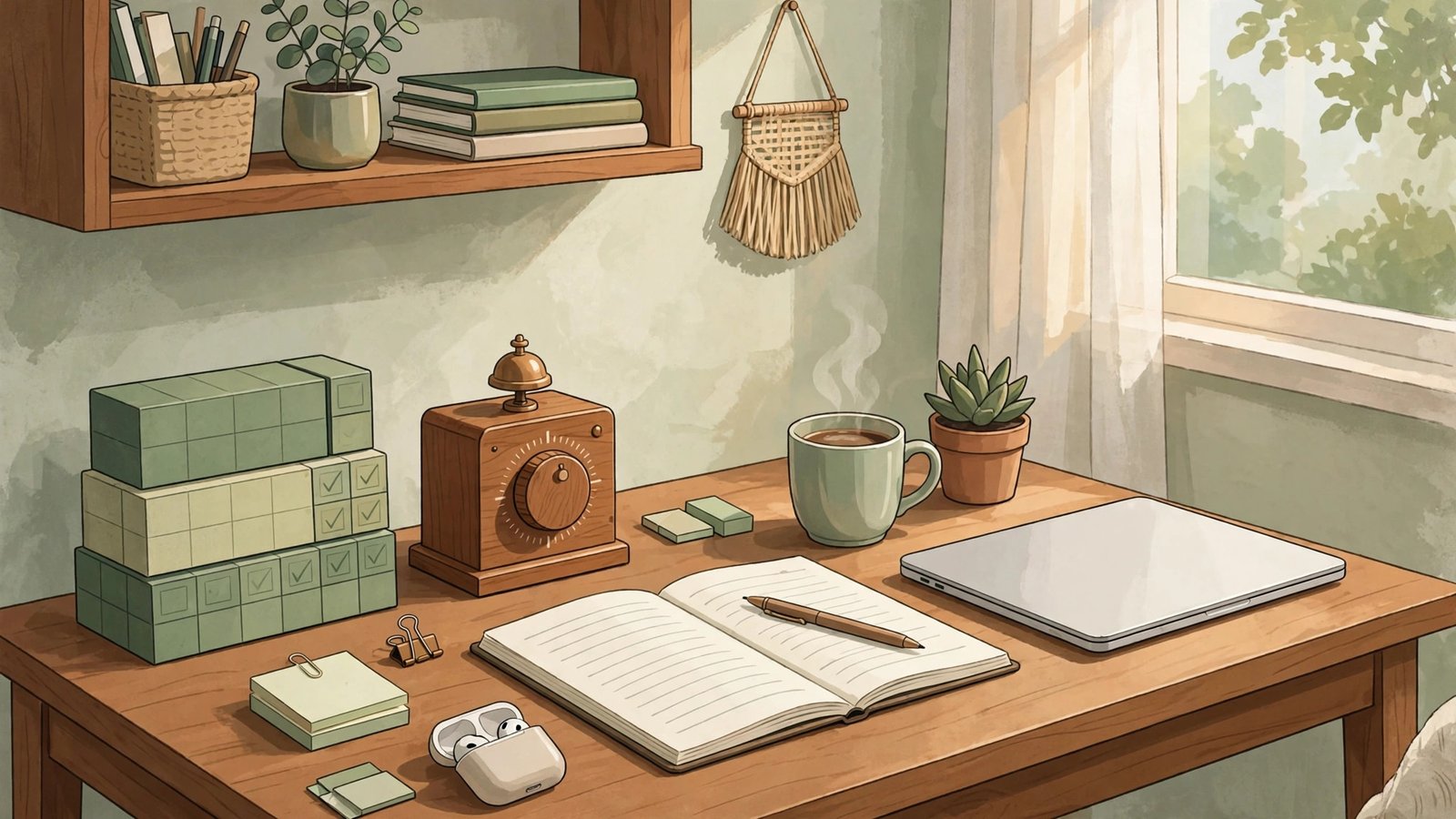
Your environment is quietly giving you instructions all day. A sofa says relax; a kitchen table says snack and chat. You do not need a spare room — you need a consistent spot that your brain learns to associate with one thing only: work.
- One place, only for work: A desk, a corner, even one particular chair. Never work from bed; the association works in both directions, and the sofa will soon start to feel like the office.
- Set it up once, properly: Screen at a comfortable height, chair that supports a full day, charger, water, and notebook within reach. Every trip to find equipment is an invitation to get distracted on the way back.
- Clear it at day’s end: A two-minute tidy-up and a closed laptop mark the finish line as clearly as leaving a building used to.
System 3: Time Blocking — Give Every Hour a Job
An open day invites open-ended drifting. Time blocking turns your calendar into the plan: you decide in advance what happens when, and then the only job is to follow it.
- Block deep work first: Reserve ninety minutes to two hours, ideally in your peak-energy morning hours, for your most important task. Treat this block as a meeting with your most demanding client — because it is.
- Batch the shallow work: Email and messages get two or three set windows a day, not a continuous background drip. Most messages genuinely can wait two hours; the ones that cannot will find you by phone.
- Block breaks too: Short breaks every hour or so, and a real lunch away from the desk. Unblocked breaks expand; blocked ones refresh you and end on time.
- Plan tomorrow at the end of today: Lay out tomorrow’s blocks before you finish. You will start the next morning already knowing the first move, which is half the battle won.
System 4: Rules for Distractions, Decided in Advance
You cannot out-discipline a device engineered to distract you, so change the terms of the fight with rules set once, in advance:
- Phone out of reach: In another room, or at minimum face-down in a drawer during deep work blocks. Willpower loses to proximity almost every time.
- Notifications off by default: Keep only true urgencies — calls from family, perhaps. Everything else can be checked in your scheduled message windows.
- One tab, one task: When you notice fifteen tabs open, that is the system telling you it has broken down. Close them, return to the block on the calendar, and restart.
- A “later” list: Random thoughts and errands will ambush you mid-task. Write them on a notepad beside you and return to work; process the list in a break. The urge fades once the thought is safely captured.
System 5: Manage Energy, Not Just Time
You do not have the same brain at 9 a.m. and 4 p.m., and a good system respects that. Put demanding, creative, or difficult work in your natural peak hours, and schedule admin, calls, and routine tasks for the afternoon dip. Protect the basics that set your energy level in the first place: sleep, daylight, movement, and food that is not eaten standing at the fridge between meetings. A short walk at lunch is not a luxury — for most people it buys back a noticeably sharper afternoon. Notice for one week which hours you do your best work, then defend those hours for your most important tasks.
System 6: An End-of-Day Shutdown
Remote work’s quietest trap is that it never quite ends, and an evening spent half-thinking about work ruins both the evening and the next morning. Build a shutdown ritual of about ten minutes:
- Review the day: tick off what got done, and move anything unfinished to a named slot tomorrow — out of your head, onto the plan.
- Write tomorrow’s top task at the top of your list, and set out anything you need for it.
- Close every work tab and app, tidy the desk, and say a set phrase if it helps — many people use a literal “shutdown complete”. It sounds silly; the ritual is the point.
- Then actually stop: no “just checking” email in the evening, which restarts the mental loop you just closed.
Frequently Asked Questions
What if my job involves constant messages and meetings?
Then your blocks get shorter and your message windows more frequent — the system adapts, it does not disappear. Even two protected forty-five-minute blocks a day for real work, with set times for everything reactive, puts you ahead of a fully reactive day. Negotiate response-time expectations with your team where you can; most “urgent” cultures are habits, not requirements.
How do I stay focused with children or others at home?
With honest signals and agreements rather than hope. A closed door or headphones that mean “interrupt only for emergencies”, shared calendars for meetings and quiet blocks, and planned time with family placed in the schedule rather than stolen from it. Coordinate your deepest work with naps, school hours, or a partner’s shifts where possible, and lower the bar on difficult days — a system that bends survives; a rigid one breaks.
I have tried routines before and they never stick. What is different here?
Usually the routine was too big, too vague, or built on a bad day’s ambitions. Start embarrassingly small: one fixed start time, one planning minute, one deep-work block. Run it for two weeks until it feels automatic, then add the next piece. Systems stick when each layer is boring and easy — motivation follows habit far more often than habit follows motivation.
Which apps do I need for all this?
Almost none. A calendar for time blocking, a notes app or paper list for planning and the “later” list, and your phone’s built-in focus mode cover everything in this guide. Add a website blocker only if a specific site keeps defeating you. The system is the point; tools should stay invisible.
Conclusion
You do not need more discipline to work well from home. You need a start routine instead of a commute, a workspace that means business, a calendar that has already decided, distraction rules set in advance, work matched to your energy, and a shutdown that ends the day properly. Build those six systems one small piece at a time, and productivity stops depending on how motivated you feel — it just happens, because the structure carries you.
Subscribe to Go Digital Professional for more practical guides on remote work, freelancing, and building a digital career that works for you — delivered straight to your inbox.